
Blog
Furniture Manufacturer vs Export Trader: What B2B Buyers Need to Know

In the competitive landscape of Indian exports, distinguishing between a direct furniture manufacturer and an export trader is becoming increasingly difficult. For a professional buyer, this isn’t just a matter of “who owns the building” – it is a matter of supply chain risk, quality control, and lead-time reliability.
As a furniture manufacturer in India based in the hub of Jodhpur, we see how the “online mirage” often masks the reality of production. Here is how to look past the website and understand what truly impacts your bottom line.
The “Online Mirage”: Why Every Supplier Looks Identical
Most B2B buyers are flooded with cold emails daily. Every website features high-quality factory photos, claims of “in-house production,” and massive catalogs.
The Reality: Many “suppliers” are actually export traders. They act as intermediaries who source from various small workshops. While they may handle documentation well, they do not control the production floor.
Why the distinction matters to your business:
- Production Delays: Traders are at the mercy of their sub-contractors’ schedules.
- Quality Drift: When a trader switches workshops to save costs, your product quality changes without notice.
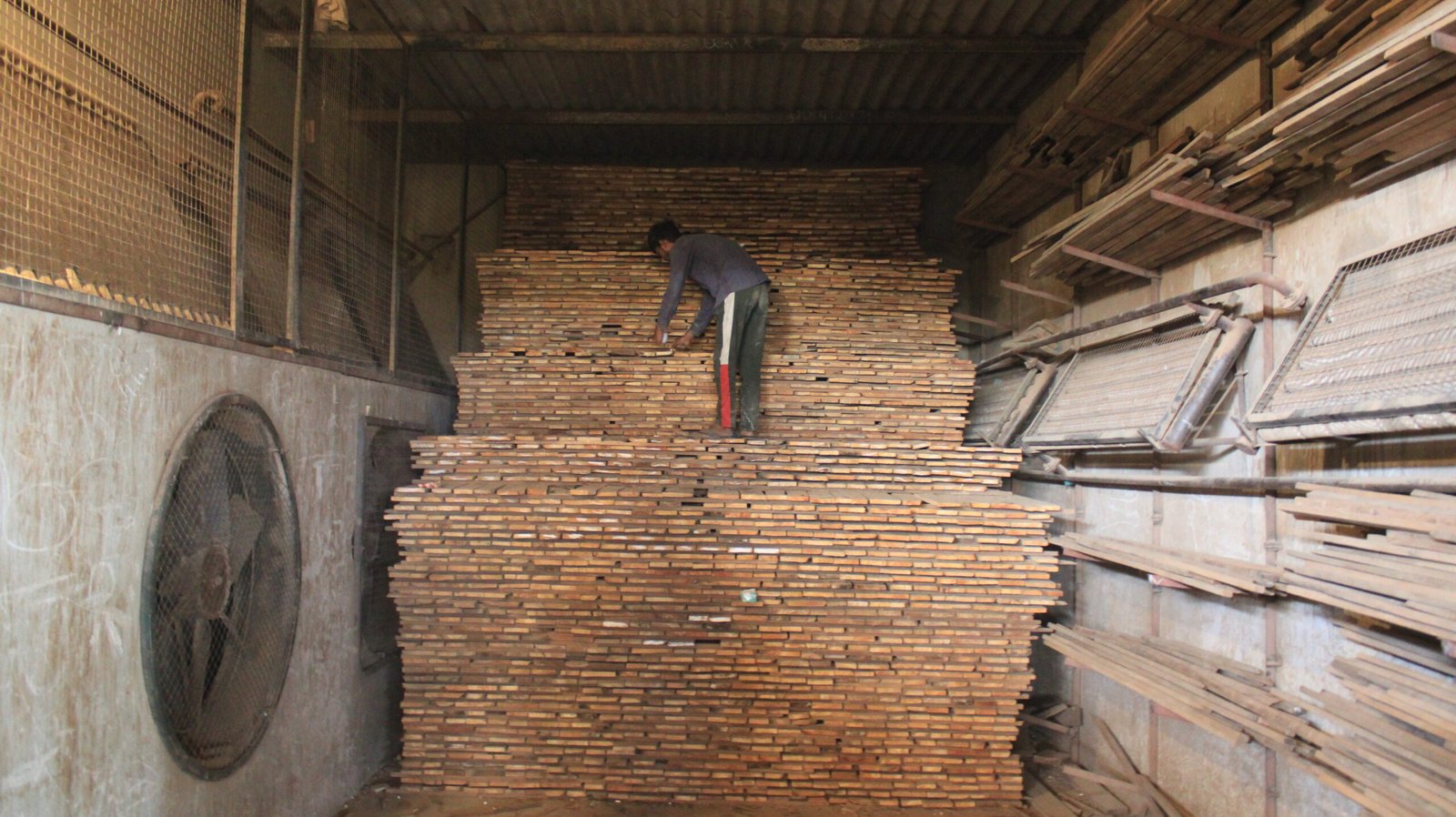
- Seasoning Risks: If the wood isn’t seasoned in a controlled environment, your furniture will crack once it reaches its destination.
The Manufacturer Advantage: Control from “Log to Loading”
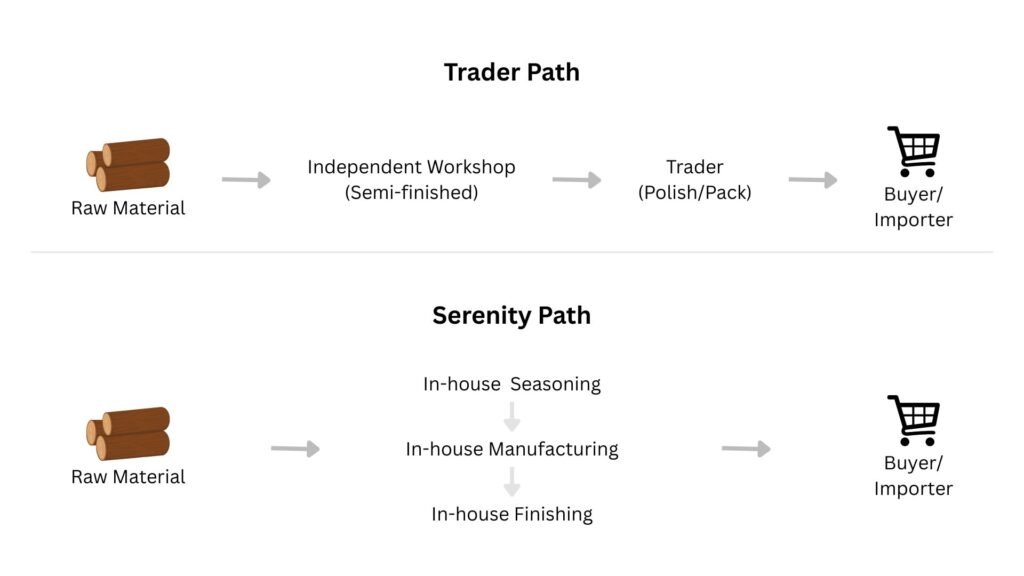
In the Indian furniture industry, the term “manufacturer” is often used loosely. A common model involves an export trader purchasing semi-finished products from various small, independent workshops. These workshops handle the heavy lifting – cutting, joining, and basic assembly – often without standardized quality oversight. The trader then merely applies the final finish (polish/paint), packs the item, and ships it.
The “True Manufacturer” difference: A true manufacturer does not start with a semi-finished frame; we start with the raw material.
- In-House Timber Processing: We process raw wood in our own plant. This ensures the wood is seasoned and chemically treated before a single nail is driven.
- Structural Integrity: Because we build the furniture from scratch, we control the joinery, the internal reinforcement, and the glue quality – elements that are hidden once a trader applies polish.
- Total Accountability: When a trader buys a semi-finished piece, they cannot guarantee what is under the paint. When we manufacture in-house, we own the quality of every square inch, from the raw timber to the final hardware.
Manufacturer vs. Trader: At a Glance
| Feature | Direct Manufacturer | Export Trader |
|---|---|---|
| Lead Time Control | High (Owns the schedule) | Low (Dependent on 3rd parties) |
| Material Seasoning | In-house Kilns/Processing | Outdated/Market Sourced |
| Accountability | Direct (One point of contact) | Fragmented (Blames the factory) |
| Pricing | Transparent, Factory-Direct | Commission/Markup Included |
| Capabilities | Solid wood, Metal, Cane, Marble | Limited to what their source makes |
How to Verify Your Supplier (The 5-Minute Test)
Busy buyers don’t have time for long inspections. Use these three “Manufacturer Indicators” to verify your partner:
- Ask for the “Kiln Record”: If they manufacture solid wood furniture, ask for the moisture meter readings or a photo of their seasoning plant.
- The Live Video Walk: Ask for a 5-minute video call. A real Indian furniture manufacturer can walk from the office to the production floor immediately. A trader will usually ask to “schedule it for tomorrow.”
- Check the Variety: Traders often have catalogs that look like a “mismatch” of styles. Manufacturers usually have a cohesive design language across Contemporary, Industrial, and Bar furniture.
Why Jodhpur Remains the Hub for Professional Sourcing
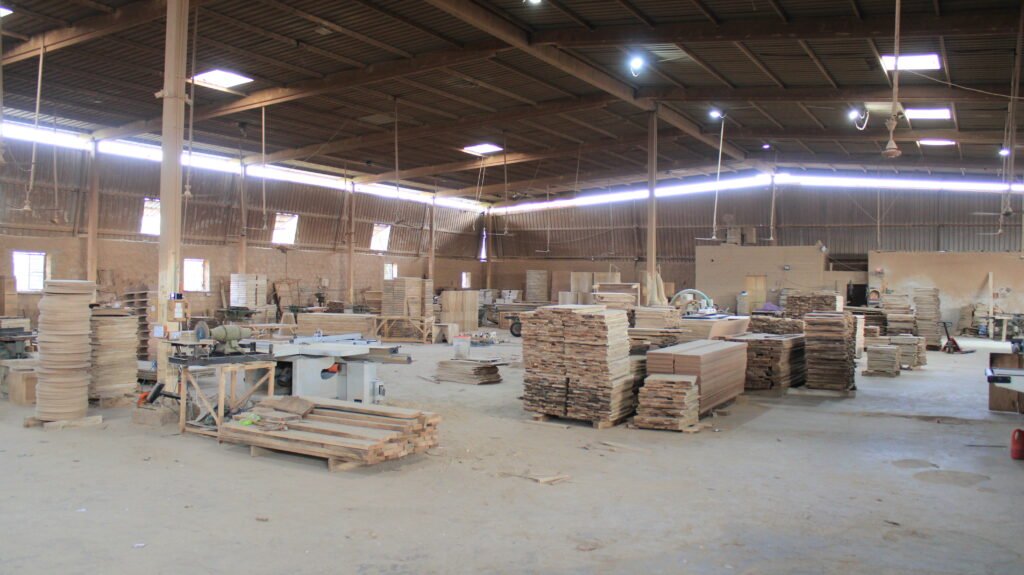
Jodhpur is globally recognized as the “Handicraft Capital,” but for a B2B buyer, the city offers two very different types of sourcing. The reason Jodhpur remains the hub is the sheer concentration of specialized skill in wood, metal, and stone. However, the professional buyer’s challenge is navigating the fragmented supply chain.
- The Workshop Network: Jodhpur is filled with thousands of tiny workshops. While talented, these workshops often lack the infrastructure to handle large-scale retail chain requirements or international compliance standards.
- The Professional Bridge: This is where an organized furniture manufacturer in Jodhpur like Serenity International becomes essential. We provide the “Professional Shield” by centralizing all production.
- Consolidated Engineering: Instead of your order being spread across five different small workshops with five different quality levels, a true manufacturer ensures that every piece in your 40ft container is identical in construction and finish.
For the buyer, Jodhpur offers the craft, but the direct manufacturer offers the system to deliver that craft reliably at scale.
Frequently Asked Questions
Is it cheaper to work with a trader or a manufacturer?
Initially, a trader might offer a lower “sample” price by sourcing from a low-cost workshop. However, for long-term programs, a manufacturer is more cost-effective due to lower defect rates and direct-from-factory pricing.
Can a manufacturer handle mixed containers?
Yes. Large-scale manufacturers in India are now equipped to handle diverse materials like cane, marble, and metal in-house, allowing for consolidated shipments without the need for a trader.
How does Serenity International ensure quality consistency?
By owning the manufacturing process – from the raw timber plant to the metal fabrication unit – we eliminate the “surprises” that happen when production is outsourced to third parties.
